Relaxation or Repair? A Straight-Talking Guide to Picking Your Next Massage
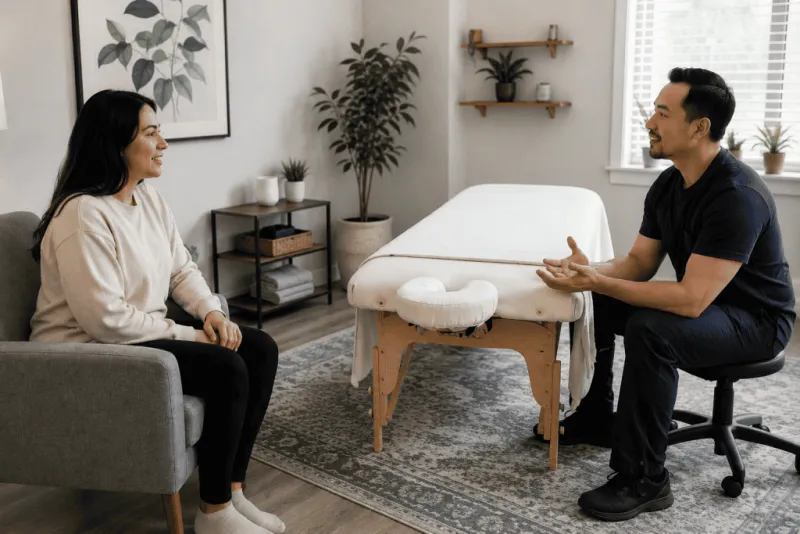
Photo: massage therapist consulting with client in calm treatment room UK, via www.integrativehealthcare.org
Two Massages, Two Very Different Jobs
Walk into any massage studio in the UK — from a Brighton seafront retreat to a quiet treatment room in Manchester's Northern Quarter — and you'll usually spot two words on the menu more than any others: Swedish and deep tissue. They sound interchangeable. They're not.
Swedish massage is what most people picture when they think of a massage: long, flowing strokes, gentle kneading, warmth spreading through the muscles. Its purpose is relaxation — calming the nervous system, boosting circulation, lowering stress. Deep tissue, by contrast, is a working massage. Practitioners use slower, firmer pressure to reach the deeper layers of muscle and fascia, targeting knots, adhesions and long-held tension.
One soothes. The other sorts. Knowing which one you need is the difference between floating out of the room and genuinely walking better for a fortnight.
What the Practitioners Say
"People often book deep tissue because they think harder equals better," says a senior therapist at our studio. "But if someone arrives exhausted and stressed, aggressive pressure can leave them feeling worse. Sometimes the most therapeutic thing I can do is slow everything right down."
The reverse is equally true. A client with chronic shoulder tension from years at a desk won't get lasting change from a light relaxation massage alone — the tension lives too deep for gentle strokes to shift.
A common misconception worth busting: deep tissue should never feel like punishment. Yes, it can be uncomfortable in a 'good hurt' way, but you should always be able to breathe through it. If you're tensing up or holding your breath, the pressure's too much — and a good therapist will adjust the moment you say so.
The Case for Swedish
Choose Swedish-style massage when your main issue is stress rather than structural. It's ideal if you:
- Struggle to switch off or sleep poorly
- Feel generally run down rather than in pain
- Are new to massage or sensitive to pressure
- Want improved circulation and a mood lift
There's solid reasoning behind the feel-good factor, too. Slow, rhythmic strokes activate the parasympathetic nervous system — your body's rest-and-digest mode — which is why so many people leave a relaxation massage feeling almost drowsy.
The Case for Deep Tissue
Deep tissue earns its keep when tension has settled in and stayed. It's the better fit if you:
- Have persistent knots in the neck, shoulders or lower back
- Train hard at the gym, run regularly, or play weekend football
- Sit at a desk most of the day (hello, hybrid workers)
- Feel restricted in your range of motion
Expect the therapist to work more slowly and deliberately, sometimes using forearms or elbows. You may feel tender for a day or two afterwards — a bit like post-gym soreness — so hydration and a warm bath help.
A Quick Self-Assessment Before You Book
Run through these five questions honestly:
- Is my main problem pain or stress? Pain, stiffness or restricted movement leans deep tissue. Stress and fatigue lean Swedish.
- When did the tension start? A stressful week calls for relaxation. A nagging shoulder from 2019 calls for something more targeted.
- Have I had massage before? If it's your first time, Swedish is a gentler introduction.
- Am I recovering from an injury? Check with your GP or physio first — some conditions need clearance before firm pressure.
- What does my body feel like the morning after exercise? If you already ache constantly, piling on intense pressure may not be the answer just yet.
Still Torn? Say So
Here's the thing most people don't realise: you don't have to choose in a vacuum. A decent therapist will ask about your lifestyle, posture and problem areas before laying a hand on you — and can blend approaches within a single session, starting relaxing and working deeper where it's needed.
At Allure, we'd rather spend five minutes chatting about your body than have you book the wrong treatment. Whether you need an hour of pure switch-off or some serious work on those knotted shoulders, the right massage is the one that matches your body — not just your mood on the day.