What's Actually Inside a 'Knot'? The Science Behind That Bitter-Feeling Spot in Your Shoulder
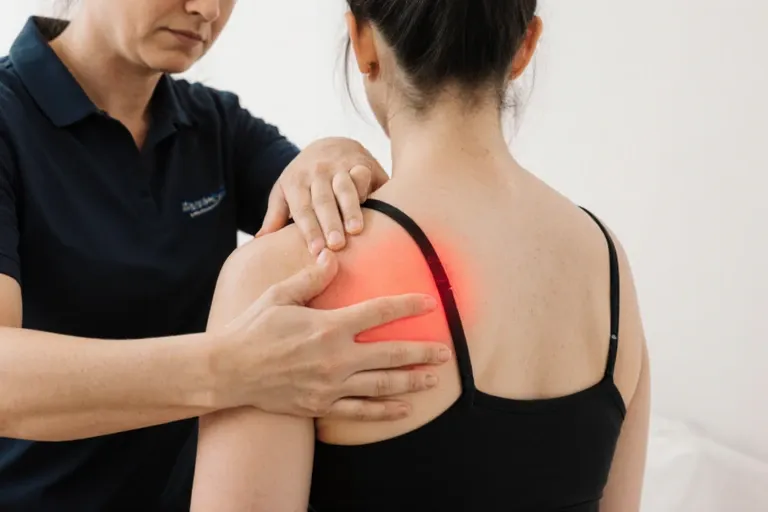
Photo: massage therapist pressing shoulder blade muscle close up treatment room, via physiochirowellness.ca
Ask anyone on the high street in Leeds or Lewisham why they book a massage and you'll hear the same word: knots. That stubborn ache between the shoulder blades. The crunchy patch at the base of the skull. The pea-sized lump in a calf that flares up after a long drive up the M6.
But here's the awkward truth: when researchers have looked under the microscope, they've never actually found a knot. Not one. So what on earth are we all kneading?
So where did the knot idea come from?
The knot is a lovely piece of folk anatomy. If a rope snarls, you pull it apart; if a muscle feels ropey, the same logic seems to apply. The image is intuitive, tactile and reassuring — which is exactly why it stuck.
The trouble is, muscle tissue is nothing like rope. It's a living, hydrated, constantly remodelling tissue, and the tender, tense patches you feel don't correspond to any twisted tangle that a surgeon could snip out. Plenty of people with agonising 'knots' show no unusual texture at all, and plenty of lumpy, ropey areas cause no pain whatsoever.
The leading suspects
So if it's not a literal knot, what's going on? A few theories dominate the conversation.
Trigger points. This is the term you'll hear most often in clinic. A trigger point is a hyper-irritable spot within a taut band of muscle — press it and you may get a sharp local twinge, or a referred ache somewhere else entirely (a classic being the spot near your shoulder blade that sends pain up into your neck or down your arm). The dominant theory suggests the muscle fibres in that patch are stuck in a state of sustained contraction, possibly because the nerve endings that tell fibres to switch off aren't doing their job properly. Sustained contraction squeezes the local blood supply, the area gets short on oxygen, nasty metabolites build up, and the nerves get grumpier — a self-perpetuating loop.
Fascia. Muscles are wrapped in fascia, a slippery connective tissue that lets everything glide. When fascia gets dehydrated, stiff or sticky — after injury, immobility or long stretches at a desk — tissues stop sliding smoothly, and that can feel dense, tight or tender. Some researchers think much of what we call a knot is a fascial rather than a muscular phenomenon.
Sensitised nerves. Sometimes the issue isn't the tissue at all but the messaging. After weeks of poor sleep, stress or repeated strain, the nervous system can turn the volume up on signals from a particular area, so perfectly normal tissue feels painful to press. This 'central sensitisation' explains why stress and tension so reliably produce sore shoulders.
Genuine inflammation or micro-spasm. After an acute strain, local swelling and protective muscle guarding can create a very real, very tender lump — though that's a different beast from the chronic, vague knot most people complain about.
The honest answer is that it's probably a mix of all of these, varying from person to person and even from spot to spot on the same body.
Can you actually 'break up' a knot?
In a word: no — and that's fine. Muscles can't be torn apart and reassembled like pastry. What firm pressure and skilled hands can do is well supported, just less dramatic than the language suggests:
- Reducing the contraction. Sustained pressure, stretching and movement can help those stuck muscle fibres let go, at least temporarily.
- Restoring blood flow. Working an area encourages circulation, flushing out the metabolic by-products that keep nerves irritated.
- Rehydrating and mobilising fascia. Slow, sustained techniques and movement give stiff connective tissue a chance to regain some glide.
- Turning the volume down. Perhaps most importantly, massage gives the nervous system strong, pleasant sensory input — which can dial down pain sensitivity in the area. This is why even a 'light' massage can ease a spot that feels rock hard.
Notice that none of this involves physically demolishing anything. The 'good pain' of a deep massage isn't a knot being crushed; it's your nervous system responding to input. That's also why gritting your teeth through agony tends to backfire — pain makes muscles guard, not release.
What to realistically expect
A few honest expectations worth carrying into your next appointment:
- Some relief is often immediate, but it may not be permanent. A knot that took three months of commuting and deadlines to build rarely vanishes in one session.
- Change comes from a combination — hands-on treatment plus movement, hydration, better desk posture and actual rest. Massage opens the door; your daily habits decide whether you walk through it.
- Tenderness doesn't equal damage. A spot can be exquisitely sensitive while the tissue itself is perfectly healthy.
- Persistent lumps deserve a check. If a lump is growing, hot, red, or the pain is worsening rather than easing, see your GP before assuming it's muscular.
Why the science makes massage better, not worse
Some people worry that admitting knots aren't literal knots somehow cheapens the treatment. We'd argue the opposite. Understanding that we're working with your nervous system, circulation and connective tissue — not performing structural demolition — is why a good therapist varies pressure, checks in with you, and combines deep work with movement and stretching rather than just leaning on the sore bit until you squeak.
So the next time you feel that familiar crunch in your shoulder, know that it's not a knot to be untied but a conversation happening between muscle, fascia and nerves. And a well-judged massage is still one of the most pleasant ways to join in.